Official Selection: Doc.Berlin Documentary Film Festival – WORLD PREMIERE
Streaming Selection: December 7 – January 7 2027
https://www.docberlin.org/streaming
Produced and Directed by Dana Plays (52m. 2026)
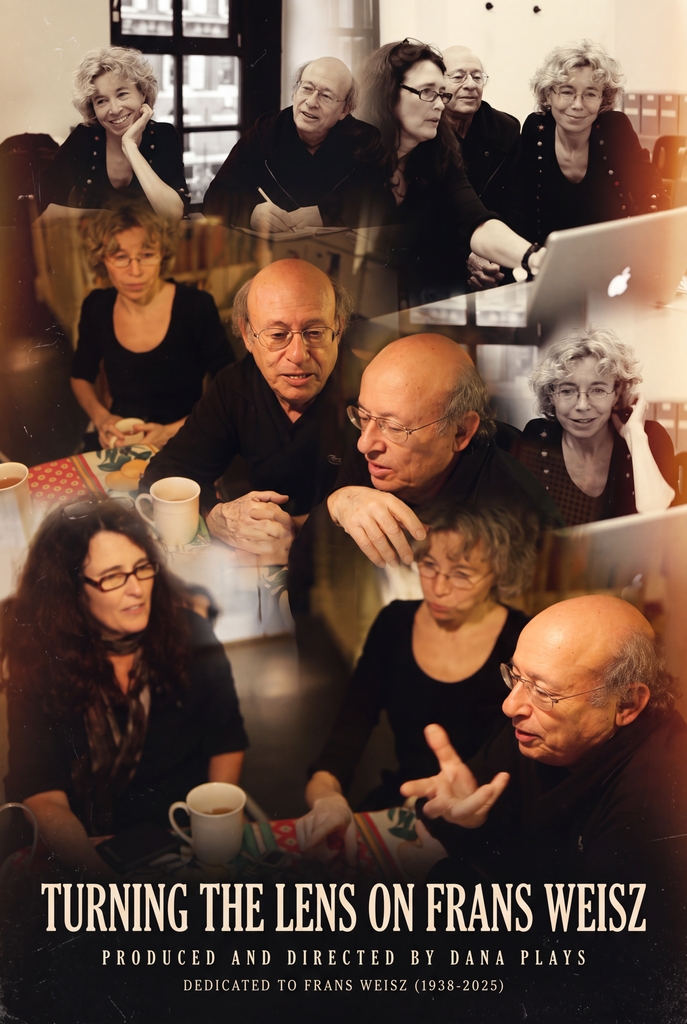
Logline: In a lively 2010 encounter at Joods Amsterdam, filmmaker Dana Plays flips the script on legendary director Frans Weisz and producer Batya Wolff, sharing exclusive footage of her cousin Didi—Ottilie Moore’s daughter—in a chuckle-filled exchange that sparked a multi-film legacy.
Short Synopsis: This engaging 52-minute meta-documentary captures the exact moment that history and family legacy collided at Joods Amsterdam in 2010. Brought in to share insights about her grandaunt, Ottilie Moore, filmmaker Dana Plays completely flips the script on producer Batya Wolff and director Frans Weisz by turning the camera back on them. What follows is a witty, high-energy exchange that brings the filmmaker’s distinct personality to the forefront as she guides the veteran directors through her own film’s development. By presenting them with her private interview with her cousin Didi (Ottilie’s daughter), the filmmaker shifts the dynamic of their shared research entirely. Dedicated to the memory of Weisz following his 2025 passing, this TV-length streaming featurette offers an intimate look at the playful spark that led to the making of the Verona International Film Festival Audience Choice winner, CHARLOTTE SALOMON’S LETTER.
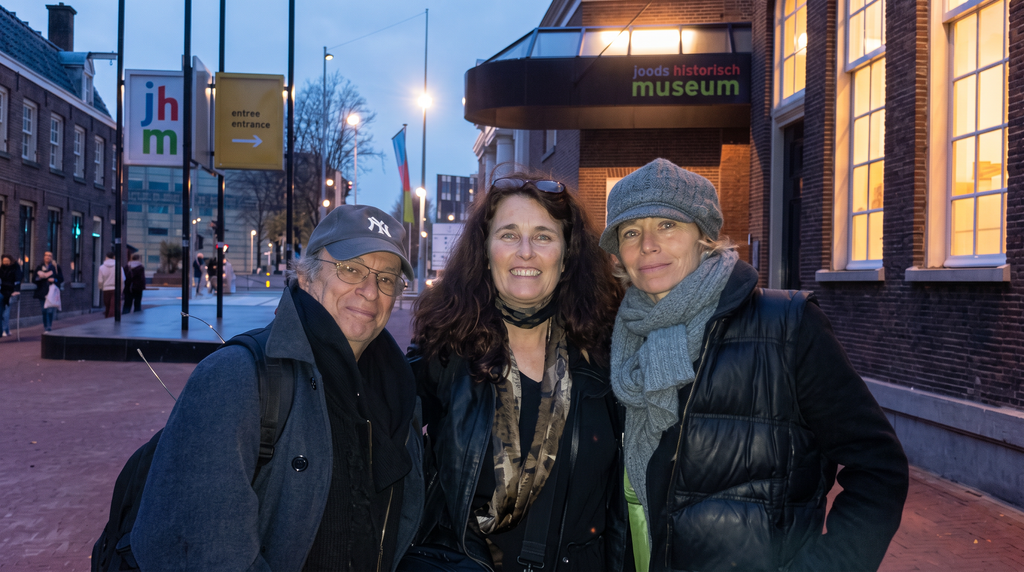
Frans Weisz, Dana Plays, Batya Wolff at Joods Museum, Amsterdam – Production Photo 2010. Dana Plays©2026
Director Biography – Dana Plays
Dana Plays is an award winning, American film director known for her documentary, narrative and avant-garde works that interweave personal themes. Plays utilizes a experimental approach to her work, weaving a rich landscape of imagery, that combines metaphor with iconography creating poetic resonance.
Dana Plays, born in Baltimore, Maryland, is a filmmaker most known for her award winning documentary and experimental films that have shown widely throughout the world. Dana Plays, born in Baltimore, Maryland, is a filmmaker most known for her award winning experimental films that have shown widely throughout the world. Plays’ filmography consists of 32 works in film and digital video, consisting of experimental films, hybrid documentaries, and installations. Her work has been exhibited at the Whitney Museum of American Art: Color of Ritual, Color of Women, Avant-Garde Women Filmmakers of the Twentieth Century and more than 50 international film festivals, including Edinburgh, Montreal Nouveau, and Seattle International Film Festivals. Her films have garnered more than 25 film festival awards including the prestigious First Prize Jurors’ Choice Award at the Black Maria Film and Video Festival for Nuclear Family; Tom Berman Award for Most Promising Filmmaker at the Ann Arbor Film Festival for Zero Hour; Best Experimental Film at the Houston International Festival for Across the Border; and Best Documentary Award at the New Orleans Film Festival for Love Stories My Grandmother Tells, which also was broadcast on VPRO, a Dutch national television network. Since 2005, Plays has had national awards and exhibitions including a Black Maria Film Festival award; a solo retrospective in Boulder, CO, at First Person Cinema, the longest standing American showcase for independent film; a digital installation of her piece Salvage Paradigm, at the Play Space Gallery, in San Francisco; a digital installations of and her video montage of Hollywood films situated in the Los Angeles River, River Madness, at the Skirball Center in Los Angeles.
Dana Plays is an award winning experimental filmmaker, digital artist and professor of Film and Media Arts at The University of Tampa. Her work has exhibited at the Whitney Museum of American Art in the exhibition The Color of Ritual, The Color of Women Avant-Garde Filmmakers in America 1930-2000, programmed by Whitney curator by Chrissie Isles, as well as other notable venues including the Pacific Film Archive, SF Cinematheque and more than 50 international film festivals where her films have garnered 32 film festival awards. Plays’ work consists of a variety of approaches to experimental documentary and the visual film, utilizing optically printed found footage and/or footage that she has shot.
“Plays’ work falls within the rich terrain mapped out by the feminist avant-garde as it has emerged in the last 15 years; it represents a rich and astute reworking of feminist film theory as it collides with personal lives. This feminist project attempts to reclaim memory, snapshots, recreated images, sounds, voices, and discarded footage as historical traces. The exceptionally evocative cinematography and optical reprinting laced throughout all her films suggests that Plays’ project is to use manipulated images – whether through optical printing, composition, or light – to uncover their psychic imaginaries. Very, very few feminist filmmakers have the courage to unleash the ambiguities in voice and image; most want to anchor both. As a result, all of Plays’ work asks spectators to let go as they watch, and work within the interstices between sound and image.”
-Patricia Zimmermann, Professor, of Screen Studies, Ithaca College, Codirector of
Finger Lakes Environmental Film Festival
(1955-2023)
“As a critic who writes about experimental films, I am familiar with Dana’s extensive body of film work. I have been impressed by the eclectic range of themes and techniques she has explored and developed throughout her career. In subject matter, her films range from ethnographic studies to formal explorations of the cinematic image. She is an adept documentarian, as well as master of the art of optical printing. Although her films are varied, there is a personal vision and a sense of integrity and purposefulness that unites them into a coherent whole. Dana approaches political issues such as the people of El Salvador and the United States government with sensitivity. Never heavy-handed or didactic, her films manifest her political convictions in a lyrical, personal way. Her films also have a consistent sensual richness; their lush imagery is organized into dynamic compositions that unfold with graceful rhythmic patterns of repetitions and variations.” – Christine Tamblyn, Film Critic and Scholar (1951-1998)
As the grandniece of Ottilie Moore, I began researching the material about Ottilie through my family archives and filming various refugees that she sheltered on her property. I worked closely in pre-production for the director Frans Weisz on the research and development for his prior production which coincided with the making of my films, and as a result was able to license archival media with permission from the producer Frits Harkema of Quintus Film BV, including the Birgit Doll material (with permission from representatives of Birgit Doll’s estate). Charlotte Salomon was one of those refugees sheltered and sponsored by Ottilie Moore. The Charlotte Salomon Foundation and the Jewish Historical Museum in Amsterdam have provided access to their archival collections related to Charlotte Salomon. The censored letter was finally published in 2012, which clarified Ottilie Moore role in CS’s life, and in the development of Life or Theater, and Charlotte Salomon’s entire adult oeuvre, commissioned and sponsored by Ottilie Moore. The length of this feature is also cut as a 52-minute TV Edit.
- Distribution and Contact information
- Dana Plays
- danaplays@gmail.com
- © Copyright 2026. All rights reserved.